Germany's public EV charging points jump 24 percent in two months
Section: News
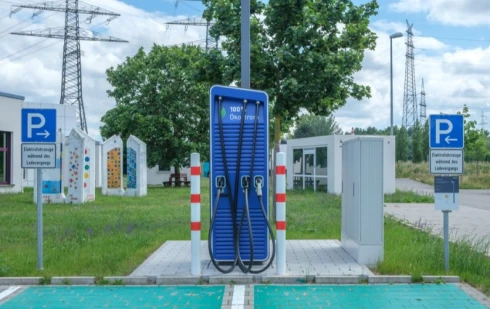
The number of public charging points for electric vehicles in Germany rose sharply over the summer, climbing 24 percent between July and September, according to new figures from the Federal Network Agency analysed by energy company 1Komma5Grad for its so-called charging point atlas.
The agency had just over 209,000 public charging points registered as of September 1. That total included roughly 150,000 standard charging points and nearly 59,000 fast chargers, the analysis found. The figures were made available in advance to the German Press Agency.
Among Germany's 107 independent cities, Stuttgart remained the clear leader by a wide margin. The capital of Baden-Württemberg had 2,107 charging points per 100 square kilometers as of the reference date, a 12 percent increase compared with roughly a year earlier.
Regensburg ranked second with 1,452 charging points, up 19 percent, followed by Munich with 1,179 points, also a 19 percent rise.
At the other end of the ranking, Brandenburg an der Havel had 59 charging points per 100 square kilometers, though that marked a 42 percent increase. Dessau-Roßlau had 55 points, up 15 percent, while Suhl recorded the lowest density among the cities surveyed, with 53 charging points per 100 square kilometers, a gain of 6 percent.
The steepest percentage increases were not concentrated in the largest metropolitan areas, the analysis showed. In Schwabach, a city in Bavaria, the number of charging points surged 112 percent to reach 172. In Mülheim an der Ruhr, the count climbed 89 percent since July 2025, reaching 429 charging points per 100 square kilometers.
Among Germany's 294 rural and urban districts, there was a change at the top of the rankings. The district of Mettmann in North Rhine-Westphalia recorded growth of 40 percent and now leads with 344 charging points per 100 square kilometers, a spokesperson for 1Komma5Grad said.
That growth pushed the district of Böblingen in Baden-Württemberg, which had 328 charging points and posted a 19 percent increase, down to second place. The Main-Taunus district took third position with 281 charging points, a rise of 15 percent.
Jannik Schall, head of product at 1Komma5Grad, described the overall growth in charging points as a positive signal. He noted, however, that the expansion of charging infrastructure was uneven across the country.
"The charging infrastructure is growing unevenly," Schall said, according to the company. "While metropolitan areas are being densely supplied, the picture looks less favorable in small towns and rural regions."
He added that these areas still needed significant catching up if the shift toward electric vehicles was to succeed nationwide, rather than concentrating growth in Germany's largest cities.
The data reflect registrations with the Federal Network Agency as of September 1 and compare figures with those recorded roughly a year earlier, as well as changes measured since July 2025 in some cases. The agency's figures form the basis for ongoing tracking of Germany's charging network as the country works to expand infrastructure to support a growing fleet of electric vehicles.
Photo by Reinhard Bruckner on Pexels
Section: News
Section: Arts

Section: Arts
Section: News
Section: Politics
Section: News

Section: Fashion
Section: Arts

Section: Fashion
Section: Fashion
Both private Health Insurance in Germany and public insurance, is often complicated to navigate, not to mention expensive. As an expat, you are required to navigate this landscape within weeks of arriving, so check our FAQ on PKV. For our guide on resources and access to agents who can give you a competitive quote, try our PKV Calculator.
Germany is famous for its medical expertise and extensive number of hospitals and clinics. See this comprehensive directory of hospitals and clinics across the country, complete with links to their websites, addresses, contact info, and specializations/services.
Didn't manage to get a ticket for Linkin Park? Or still not enough after the concert? Join us at CRASH on June 12th for our "IN THE END" Linkin Park Special + CORE NIGHT.All night long, we'll be playing Linkin Park's music, along with Nu Metal, Metalcore, and Alternative Rock from bands such as Limp...


No comments yet. Be the first to comment!