 Brazil has never been short of natural resources. Iron ore, agricultural commodities, energy, and an extraordinary range of minerals have helped establish the country as one of the world's great resource economies.

PHP vulnerability causes global disruptions
Section: Science
But beneath that familiar story, another opportunity is taking shape. And this one could have implications far beyond Brazil's traditional export markets.
The country is emerging as an increasingly important destination in the global search for rare earth elements, the specialized materials that help power everything from electric vehicles and industrial robots to fighter jets, wind turbines, and advanced electronics.
The timing is hardly accidental.
China dominates much of the world's rare earth processing and high-performance magnet manufacturing. That concentration has become a growing concern for governments and multinational corporations seeking dependable access to materials that are essential to their industries.
As geopolitical tensions and trade restrictions expose the vulnerabilities of concentrated supply chains, the search for alternative sources is gathering momentum.
And Brazil has something the world increasingly wants: substantial mineral resources with the potential to contribute to a more diversified global supply.
Why Brazil Is Becoming Harder to Ignore
The international rare earth industry is undergoing a shift that extends well beyond traditional mining economics.
Governments are reconsidering the security of critical mineral supplies. Manufacturers are evaluating where their materials originate. And established industry players are committing substantial resources to projects capable of supporting new supply chains.
Brazil is already attracting some of that investment.
In September, USA Rare Earth completed its combination with Brazilian rare earth producer Serra Verde, following an agreement initially valued at approximately $2.8 billion.
Australia's Lynas Rare Earths also announced an approximately $672 million agreement to acquire Meteoric Resources, whose Caldeira project is located in Brazil. That proposed transaction remains subject to completion.
Together, the deals represent about $3.5 billion in announced transaction values, a striking indication of the international interest surrounding Brazil's rare earth industry.
But the opportunity isn't limited to established producers or companies capable of making billion-dollar acquisitions.
Some of the most interesting work is taking place much earlier in the development process, where smaller exploration companies are investigating deposits that could eventually contribute to the next generation of mineral supplies.
An Emerging Explorer With a Substantial Brazilian Resource
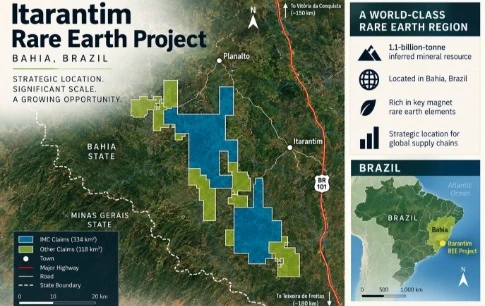
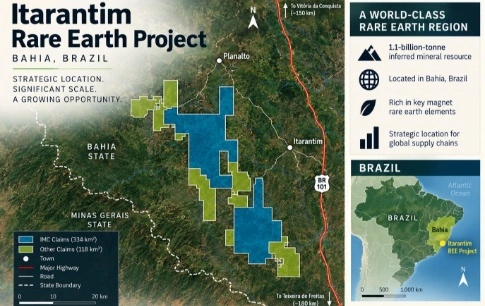
One is IMC Rare Earths Ltd., a smaller publicly traded exploration and development company advancing its Itarantim rare earth project across parts of Bahia and Minas Gerais.
The project already hosts a reported 1.1-billion-tonne inferred mineral resource, containing neodymium, praseodymium, dysprosium, and terbium, four important elements used in high-performance permanent magnets.
The scale is noteworthy. Itarantim's reported resource is approximately 20% larger by tonnage than the historically cited 911-million-tonne resource at Serra Verde's Pela Ema deposit, although the estimates come from different reporting periods and resource classifications. Tonnage alone, of course, does not establish comparable economic value.
What makes Itarantim particularly interesting is that exploration has continued beyond the boundaries of its existing resource.
On October 8, IMC announced a new high-grade, terbium-rich mineralized zone at Block H. Drilling identified a seven-meter interval averaging 5,695 parts per million total rare earth oxides, including a higher-grade three-meter section averaging 7,841 parts per million.
The mineralization begins approximately two meters below the surface, and the newly identified zone lies outside the project's established resource boundaries.
That distinction matters. It means the latest findings are opening another area for investigation rather than simply adding information about mineralization already incorporated into the resource estimate.
Additional drilling will be necessary to determine the extent and continuity of the discovery. But for an exploration company already working with a substantial defined resource, identifying promising new ground is encouraging.
And the drilling results are only part of the story.
Finding Rare Earths Is One Thing. Recovering Them Is Another.
A mineral deposit can look impressive on paper. But its commercial prospects ultimately depend on whether valuable materials can be recovered efficiently and processed into products manufacturers can use.
This is especially true for rare earth-bearing clay deposits, where mineral composition and extraction methods can significantly affect development potential.
At Itarantim, IMC has been advancing metallurgical testing alongside its exploration program, producing results that are helping researchers understand how the project's valuable elements respond to different recovery methods.
September laboratory testing reported terbium recoveries reaching 95.2% under specific conditions. The company also successfully produced a mixed rare earth carbonate, an intermediate material that can undergo further processing to separate individual rare earth elements.
Separate research conducted at the University of Brighton in the United Kingdom demonstrated 73% recovery of total rare earth elements, excluding cerium, using a different laboratory protocol.
Those results are particularly relevant because terbium and dysprosium are important ingredients in certain high-performance magnets used in aerospace systems, electric vehicles, industrial machinery, and defense technologies.
The testing has also encouraged further investigation of in-situ recovery, an approach that could potentially extract rare earth elements through injection and recovery wells rather than extensive excavation.
If proven effective at commercial scale, such methods could offer advantages involving surface disturbance, material handling, and certain infrastructure requirements.
There was another encouraging observation.
In the University of Brighton testing, uranium and thorium remained below detection limits in the recovered leachate solutions. IMC has also reported negligible deleterious elements in certain tested solutions.
These findings do not establish that the entire deposit is free of radioactivity. But they could become meaningful considerations as researchers, regulators, and potential development partners evaluate processing methods, environmental requirements, and the project's longer-term potential.
For Brazil, the implications extend beyond any single deposit. Developing effective recovery technologies could help determine how much of the country's geological potential eventually becomes commercially useful.
Brazil's Growing Expertise Is Part of the Opportunity
Mineral wealth alone does not create a successful rare earth industry. Geological knowledge, technical expertise, processing infrastructure, and access to capital all play important roles.
Brazil already possesses a substantial mining industry and a growing base of experience in rare earth exploration.
That expertise is evident in the work taking place at Itarantim.
Alexandre Rocha da Rocha, an IMC director and geologist involved in the project, has been credited with contributing to discoveries at other important Brazilian ionic adsorption clay deposits, including Serra Verde's Pela Ema project.
IMC has also engaged ANSTO Minerals in Australia to undertake further metallurgical work, adding international technical expertise to its ongoing evaluation of potential recovery methods.
The company's next priorities include continued resource definition, validation of processing approaches and potential infrastructure, and the identification of industrial, corporate, or government partners capable of supporting future development.
Those are significant steps. The distance between discovering mineralization and supplying refined rare earth products to global manufacturers remains considerable.
But they also illustrate how Brazil's rare earth opportunity is developing through a combination of domestic geological expertise, international research, and growing industrial interest.
A Bigger Role for Brazil in Tomorrow's Supply Chains
The importance of rare earth minerals is unlikely to diminish as advanced manufacturing, robotics, electrification, and aerospace technologies continue to evolve.
What may change is where those materials come from.
Governments and manufacturers increasingly recognize the risks of relying on a limited number of suppliers for resources essential to their industries. That recognition is encouraging investment in alternative mineral sources, processing capabilities, and international partnerships.
Brazil has an opportunity to participate in that shift on a meaningful scale.
The country's substantial geological resources are already drawing attention from established rare earth companies, while smaller explorers such as IMC are working to identify and evaluate additional mineral potential.
At Itarantim, the combination of an existing inferred resource, new discoveries beyond established boundaries, and encouraging laboratory recovery results illustrates how that process is taking shape.
Commercial development will require further technical studies, investment, infrastructure, and regulatory approvals. But the scientific work underway today is helping establish the information needed to evaluate what may become possible tomorrow.
And that may be where Brazil's greatest opportunity lies.
Not simply in possessing some of the minerals the world increasingly needs, but in developing the expertise, technology, and partnerships to become a more important part of how the world obtains them.
Section: Science
Section: Business

Section: News

Section: News

Section: News

Section: Politics

Section: Business
Section: Politics

Section: News
Section: Politics
Both private Health Insurance in Germany and public insurance, is often complicated to navigate, not to mention expensive. As an expat, you are required to navigate this landscape within weeks of arriving, so check our FAQ on PKV. For our guide on resources and access to agents who can give you a competitive quote, try our PKV Calculator.
Germany is famous for its medical expertise and extensive number of hospitals and clinics. See this comprehensive directory of hospitals and clinics across the country, complete with links to their websites, addresses, contact info, and specializations/services.
Didn't manage to get a ticket for Linkin Park? Or still not enough after the concert? Join us at CRASH on June 12th for our "IN THE END" Linkin Park Special + CORE NIGHT.All night long, we'll be playing Linkin Park's music, along with Nu Metal, Metalcore, and Alternative Rock from bands such as Limp...


No comments yet. Be the first to comment!